Average Reviews:

(More customer reviews)Are you looking to buy Leading Ladies: The 50 Most Unforgettable Actresses of the Studio Era? Here is the right place to find the great deals. we can offer discounts of up to 90% on Leading Ladies: The 50 Most Unforgettable Actresses of the Studio Era. Check out the link below:
>> Click Here to See Compare Prices and Get the Best Offers
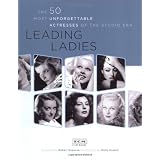
Leading Ladies: The 50 Most Unforgettable Actresses of the Studio Era ReviewI recently read this volume as well as its companion, Leading Men: The 50 Most Unforgettable Actors of the Studio Era, and thoroughly enjoyed both while agreeing with others that the selections may have been biased if executives within the Turner Classic Movies (TCM) organization were involved in the decision as to whom to include and whom to omit. For example, Ann Sheridan (who appears in films shown on TCM) but not Shirley Temple (who doesn't). That said, both volumes offer a Foreword by Robert Osborne and an Introduction by Molly Haskell and have the same reader-friendly format which consists of a brief but adequate bio of the given actress followed by "Style Notes" and "Behind the Scenes" sections. Here are a few brief excerpts.
From the brief bio of Katharine Hepburn: "Her film work kept her a star despite frequent breaks to pursue theatrical projects and care for [Spencer Tracy] as his health declined. She put her salary on the line so he could play opposite her in his last film, Guess Who's Coming to Dinner (1967). He died 17 days after filming was complete. Katharine won an Oscar for the film, but she said she could never watch it because the memories were too painful."
From the brief bio of Vivien Leigh: "Filming Gone with the Wind was a terrible experience for Vivien. She connected well with the film's first director George Cukor, but he was fired after a few weeks. Victor Fleming, a good friend of Clark Gable's, took over, and Vivien felt like a second-class citizen. Fleming's only direction to her was `Ham it up!' She secretly went to Cukor each Sunday to work on the next week's scenes. One week she accidentally ran into Olivia De Havilland, who was playing Melanie. She was doing the same thing."
From the "Style Notes" of Lauren Bacall: "When she became pregnant in the late 1940s, she designed a maternity wardrobe that was decades ahead of its time: suits and skirts that capitalized on her changing figure rather than concealing it."
From the "Style Notes" of Ava Gardner: "The sultry, appraising gaze that [she] often gives on camera is really a squint - she needed glasses but could not wear them in her pictures."
From the "Style Notes" of Marilyn Monroe: She "didn't wear anything to distract from her curves, so she wore no underwear. Often she was sown into her tight-fitting gowns."
From "Behind the Scenes" of Joan Crawford: She "would go head-to-head with anyone to keep her star status, but she met her match in Bette Davis when the longtime rivals were cast as abusive sisters in What Ever Happened to Baby Jane? (1962) Bette kicked Joan in the head so hard during a fight scene that she required stitches. When Bette had to drag Joan across a room, Joan loaded her pockets with weights, causing an injury to Bette's back that lasted for days. Baby Jane was a hit and the two were paired again for Hush...Hush, Sweet Charlotte (1964), but after three weeks of the rematch, Joan threw in the towel and quit the film." Olivia De Havilland replaced her.
From "Behind the Scenes" of Audrey Hepburn: "Initially, Gregory Peck turned down the male lead in Roman Holiday (1953) because he didn't want to play second fiddle to an unknown actress. Director William Wyler persuaded him to take the role, yet when Peck realized how wonderful Audrey was going to be in the part, he insisted that the studio give her billing equal to his. They became lifelong friends."
It would be unfair to expect more of this volume than what it was intended to be: An entertaining, often informative discussion of 50 actresses of the studio era, most of whom are "unforgettable." More a quibble than a complaint, I wish those who organized the material in this volume had also identified (preferably in an annotated bibliography) the biography of each actress which is generally regarded as most accurate and comprehensive.Leading Ladies: The 50 Most Unforgettable Actresses of the Studio Era Overview
Want to learn more information about Leading Ladies: The 50 Most Unforgettable Actresses of the Studio Era?
>> Click Here to See All Customer Reviews & Ratings Now

0 comments:
Post a Comment