Average Reviews:

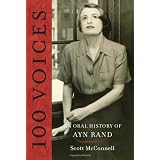
(More customer reviews)Are you looking to buy 100 Voices: An Oral History of Ayn Rand? Here is the right place to find the great deals. we can offer discounts of up to 90% on 100 Voices: An Oral History of Ayn Rand. Check out the link below:
>> Click Here to See Compare Prices and Get the Best Offers
100 Voices: An Oral History of Ayn Rand ReviewAs interest in America's greatest philosopher skyrockets and sales of her magnum opus "Atlas Shrugged" jump from 100,000 to 200,000 to 500,000 copies per year, it's wonderful to see this wealth of new material. The book's 656 pages are crammed with insights into Ayn Rand's life, character and personality, from a wide range of people and perspectives, covering every period of her life.The 100 interviews are arranged chronologically, starting with her long-lost sister Nora, who is perhaps the only one in the book to outspokenly dislike Ayn Rand. The sisters were close as children, but were separated upon Ayn's escape to America in 1926. By the time they were eventually reunited in 1974, Nora had been psychologically broken; Ayn Rand offered her a chance to stay in the United States, but she chose to return to the Soviet dictatorship. No wonder the two sisters failed to get along.
There are interviews with friends, relatives, students, philosophers, economists, her lawyers, agents, doctors, dentist, veterinarian, West Point officers, and many others. As movie producer Al Ruddy said of "Atlas Shrugged," this book is an "embarrassment of riches" (p. 509)One new perspective is offered by four interviews with those who were children when they met Miss Rand:
Rosalie Wilson, her "goddaughter," whom Miss Rand and her husband Frank O'Connor cared for during one summer in the late 1920s, when Rosalie was six, has this to say:
"I liked her, she was sweet to me, she was kind of distant .... Frank and Ayn didn't look down to me and just were very matter of fact, and I liked it .... They didn't think of themselves as older and me as younger. I was never baby-talked to. They treated me like a person ." (pp. 30, 32)
Tammy Vaught's family hosted Miss Rand at Cape Canaveral in 1969:
"Mrs. O'Connor came to stay at our house during that weekend Apollo 11 was launching, and I also got to know her through her [postage] stamps. She was just a nice lady .... I was only eleven or twelve at the time .... We mainly talked about stamps, and things I'd done at school, and my friends ...[She] was more of a grandmother, or an older person, that just took an interest in you, and just kept in touch .... She didn't act like a famous person .... They were very nice to us, and wrote back to us .... She was like a friend." (pp. 414-421)
Anna Lively, in 1978, just before her twelfth birthday:
"she looked like somebody's little grandmother ... She was so warm and sweet ... And I felt totally at ease; she didn't make me nervous, because she was so friendly, and so loving and sweet." (p. 282)
Dana Berliner, aged eleven, also met Ayn Rand in 1978:
"I remember being surprised by how nice she was. I had thought that she was going to be somewhat frightening, but she was really, really sweet, and I remember thinking initially that she was like someone's grandmother. She was very easy to talk to. She asked me a lot about what my school was like, and what I liked about it, and what the classes were like .... I asked her what she thought about children. She replied that childhood is a time when your mind is coming alive and that children are capable of understanding things and thinking about issues." (pp. 533, 534)
* * *
Miss Rand's personality comes up again and again, throughout the interviews. Avowed communist Patrick O'Connor, who was her editor at New American Library, says: "She was wonderful and warm-hearted and sensitive and friendly and charming ... People think she was other than she was, but I tell you that in my experience she was sweet-natured." (pp. 450, 455)
Most interviewees say the same thing:"My goodness, she was a very sweet lady," "Warm and friendly," "She was very generous to me," "she exhibited at times a shining, childlike innocence," "I thought she treated people with respect and cordiality. She was never rude--she was emphatic without being unpleasant," "There were no hidden agendas--no ego agendas--no personality things anybody had to get out," "Very much like a young girl, open to life and to happiness, and a `face without pain or fear or guilt' ... very open, uncomplicated," "Quiet surprised to find her so easy to be with," "I found her charming, and I thought she was very gracious," "Charming, friendly. She was fun; she was nice," "Never in all the years that I knew her did I ever see her be anything other than kind and very generous with her time," "she was so gracious," "Miss Rand was so sweet and considerate," "She was genuinely warm, gracious and kind, and immediately made me feel very comfortable and relaxed," "I remember this gracious, pleasant, well-mannered woman, a lady, in the best sense of the term," "There was absolutely no `Do you know who I am?' or `Do you know to whom you're talking?' That was simply not in her character," "I was expecting to meet an intellectual Sherman tank, all focused, intent, serious ... [but] the atmosphere became one of happiness, benevolence, consideration, even warmth."These interviews should thoroughly discredit the smears in Barbara Branden's malicious pseudo-biography, which she did not publish until Miss Rand was dead and could not sue for libel.
Professor John Ridpath comments appropriately: "those who seek to diminish her, to characterize her negatively, are--to paraphrase Nietzsche's condemnation of Christianity--a rebellion of everything that crawls on the ground, against that which has height." (p. 360)
Miss Rand's long-time cook and housekeeper Eloise Huggins, too, expresses shock at Branden's slurs against Frank O'Connor. (p. 441) Secretary Cynthia Peikoff describes a dishonest trick Barbara Branden tried to pull, in an attempt to gain legitimacy for her book (pp. 553-555).
There are so many fascinating sidelights offered in "100 Voices" that I can only refer to a few of them:
Actor Robert Douglas, who portrayed villain Ellsworth Toohey in the movie version of "The Fountainhead," really agreed with the book's message: "I thought it was wonderful, a very exciting book" (p. 69)
Al Ramrus, having read only the bad reviews of "Atlas Shrugged" and not the book itself, asked her, "Is it possible you get these lousy reviews because you're a lousy writer?" Miss Rand walked into the other room, returned with a copy of "Atlas," and said "Find an example of lousy writing." Ramrus looked for one, tried page after page, finally looked up and acknowledged he couldn't. He later became an enthusiastic supporter of her ideas. (p. 158)
Miss Rand's reaction to a Martin Luther King demonstration in New York City that blocked traffic, causing the patient in an ambulance to die (p. 177)
Her reaction to the shooting of President Kennedy (p. 177)
"You need some things in life that are just fun, that are frivolous" (p. 184)
She had unexpected admirers in writer Mickey Spillane (p. 232), rock guitarist Duane Eddy (p. 364), and actress Racquel Welch (p. 566).
Miss Rand disliked Ronald Reagan, because in the 1940s when Communist infiltration in the movie industry was a serious problem [don't let anyone tell you differently: learn the facts before you repeat any ill-informed smears about "McCarthyism"] Reagan was for compromise (p. 283)
In 1964, following her interview in "Playboy," Miss Rand played a wicked practical joke on Hugh Hefner's publicist at the Playboy Club (p. 298)
Her opinion of fractional-reserve banking (pp. 353-354)
Her beloved cats, Frisco, Thunderbird, etc. (numerous references)
Duane Eddy guessed what song really inspired "the Song of Broken Glass" (in "We the Living") (p. 366)
She got to speak on the phone with her favorite director, Fritz Lang shortly before he died, and tell him how highly she thought of his great silent film "Siegfried;" Lang in turn said he was an admirer of hers (p. 469)
After Stalin's regime effectively cut off communication in the 1930's, Miss Rand had no news of her family back in Russia. USIA worker Lilyan Courtois relates how in 1973 she received a letter from a woman behind the Iron Curtain, saying she recognized Ayn Rand's name and asking that her letter be forwarded to the writer. As Ms. Courtois read the letter over the phone to Miss Rand, "she realized who it was from--her sister Eleanora ... She got very emotional and I got emotional. She was in tears and I was in tears. She said she hadn't seen her sister in 47 years and said, `She's alive. I thought she was dead.'" (p. 472)
Her life centered so much around her husband Frank O'Connor that her internist said, "She made less fuss about her [lung] cancer than she did about him having a cold or bronchitis" (p. 501)
Miss Rand chose Valhalla Cemetery as the final resting place for her husband and herself, because Rachmaninov was buried there (p. 530)
Miss Rand said the Beatles wrote music, compared to "noise" of the pop music that came after them (p. 590)
At the age of six, Ayn Rand's future husband Frank O'Connor took himself out of the Catholic school his parents had sent him to, and enrolled himself in the Ohio public schools. "Ayn said he was harder against religion than she was." (p. 598)
She wanted Vincent Price to play James Taggart, in the movie version of "Atlas" (p. 602) Tom Selleck or Clint Eastwood to play Rearden, and Racquel Welch to play Dagny (p. 516)
She thought she could edit Galt's speech down to three to seven minutes; no one else but she could do it (pp.517-518)...Read more›100 Voices: An Oral History of Ayn Rand Overview
Want to learn more information about 100 Voices: An Oral History of Ayn Rand?
>> Click Here to See All Customer Reviews & Ratings Now

0 comments:
Post a Comment