Average Reviews:

(More customer reviews)Are you looking to buy Golden Dreams: California in an Age of Abundance, 1950-1963 (Americans and the California Dream)? Here is the right place to find the great deals. we can offer discounts of up to 90% on Golden Dreams: California in an Age of Abundance, 1950-1963 (Americans and the California Dream). Check out the link below:
>> Click Here to See Compare Prices and Get the Best Offers
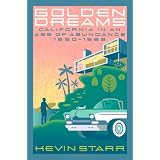
Golden Dreams: California in an Age of Abundance, 1950-1963 (Americans and the California Dream) ReviewGolden Dreams: California in an Age of Abundance, 1950-1963 (Americans and the California Dream)Kevin Starr is himself a wondrous California resource. He seems to know all things California and this is the eighth volume in his "Americans and the California Dream" series. Opening it I felt like I was entering one of those latter-day off-beat supermarkets originating in the Golden State, encountering a cornucopia and expecting to be surprised by some of what I might find (or not). I was not disappointed.
Starr has a scholar's command of the material and a home-boy's affection for his subject. His great strength is as a compiler, distiller, and packager of the extensive historical literature on the state. This particular volume covers his own formative years (he is a San Francisco native) and it shows, favorably.
Golden Dreams is fact-jammed, but Starr renders it palatable by typically telling us just enough to humanize each of hundreds of persons whom he has selected to portray the culture, society, and politics of this period. Fortunately for both the author and his readers, California seems to have long had more than its share of memorable characters. Wisely, he does not adhere strictly to the 1950-1963 time boundaries when it is helpful to have retrospective context or to project toward later consequences.
The book includes five major sections covering suburbanization, the major cities (Los Angeles, San Francisco and San Diego), politics and public works, selected aspects of culture, and what Starr calls dissenting opinions (primarily environmental and civil rights issues). The "Politics and Public Works" section, for example, ably documents how California prosperity was built on public investment, especially in the defense and aerospace industries, highways, water works, and higher education.
Certain imperfections are noticeable but tolerable in this expansive survey. Some readers may question the relative emphases Starr (or his editor) gives to certain life and culture topics. For example, there is an entire chapter on San Francisco regional literature, which in this context seems inordinately inclusive of many comparatively minor writers. So too, four pages on Tiki restaurants seem too much. On the other hand, I enjoyed his chapter on jazz (others may not, but I am a fan), and I felt it justified to balance West Coast contributions against those of New York, New Orleans, and Chicago, for instance.
As in one of the new-fangled California supermarkets, a few staples are missing. Surprisingly, Starr does not give sufficient attention to certain of the state's major industries. While he discusses the water and migrant labor politics of agriculture, we are mostly left to wonder about its variety, technologies, transformations, environmental impacts, and contribution to the state's economy. And although he identifies particular films and television shows and their stars to support various points throughout, he offers no systematic discussion of these industries as businesses during this period. Nor does he assess at any length how the advent of television viewing altered the lives of not just Californians, but Americans generally.
Starr's coverage overwhelmingly focuses on Southern California and the Bay Area, fair enough based on the population distribution. However, the counties north of Marin and Sonoma are left out altogether (except for occasional mention in relation to statewide political issues), the Central Valley receives very little attention, and Sacramento is noted only as a place where politics are done and Joan Didion grew-up.
On the whole, however, Golden Dreams is not only highly engaging, it serves as a good reminder of how much certain things changed both during the fifties and since. San Francisco, for example, was still "fundamentally conservative politically," although elements had long been "liberal in matters of private life." I had forgotten that the Republican national conventions in both 1956 and 1964 were in San Francisco (what could be more far-fetched today?).
Starr believes that "the national experience and the California experience became, increasingly, a converging phenomenon" in this period. California certainly exercised a major influence on the broader popular culture. Back then this Midwestern youth, and virtually all of my peers as I recall, thought California was the place to be. Surely, however, the state's image was idealized - it was not so golden for many groups, especially the poor.
As development has overcome parts of the state and as public investment now unravels the Golden State is less the model for dreams and emulation that it was in the fifties. Nevertheless, most readers are likely to be highly appreciative of Starr's satisfying re-creation of that time and place. I would look forward to his volume to cover the remaining period in this series, 1964 to 1989, if indeed one is forthcoming.Golden Dreams: California in an Age of Abundance, 1950-1963 (Americans and the California Dream) Overview
Want to learn more information about Golden Dreams: California in an Age of Abundance, 1950-1963 (Americans and the California Dream)?
>> Click Here to See All Customer Reviews & Ratings Now

0 comments:
Post a Comment