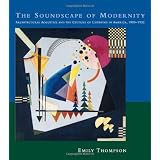
Average Reviews:

(More customer reviews)Are you looking to buy The Soundscape of Modernity: Architectural Acoustics and the Culture of Listening in America, 1900-1933? Here is the right place to find the great deals. we can offer discounts of up to 90% on The Soundscape of Modernity: Architectural Acoustics and the Culture of Listening in America, 1900-1933. Check out the link below:
>> Click Here to See Compare Prices and Get the Best Offers
The Soundscape of Modernity: Architectural Acoustics and the Culture of Listening in America, 1900-1933 ReviewThose invited to read an academic book on acoustics might well decline because of a headache, or an urgent need to wash the cat, or the constant press of quality daytime television. It would be hard to convince them that such a book could be exciting, or even interesting, especially if it weighs in with the heft of a textbook. But a remarkable work by historian Emily Thompson, _The Soundscape of Modernity: Architectural Acoustics and the Culture of Listening in America, 1900 - 1933_, ought to be enjoyed by non-specialists and those who know nothing about the science of acoustics. Thompson has written a comprehensive, well-referenced, but witty and entertaining book about an important subject whose influence is surprisingly pervasive.Thompson briskly reviews acoustic history; before this century, listeners knew there were better auditoriums and worse, but no one really knew why. To create a new venue for the important Boston Symphony Orchestra, the architect consulted a young Harvard assistant professor of physics, Wallace Sabine, who may be dubbed the Father of American Acoustics. In 1895, Sabine had been asked by the president of Harvard to improve the terrible acoustics of the lecture hall in the new Fogg Art Museum. In studying the problem, Sabine learned that the important thing to measure within a hall was the time of reverberation, the dying out of sound echoing through the room. This seems obvious now, but was the founding insight for all subsequent acoustical thought. He developed an equation relating the absorbing power of the room and its furnishings to the reverberation time. When Boston's Symphony Hall opened in 1900, the acoustics were an overwhelming success with critics. There were carpers who gradually dissented from the praise, but the musicians and the audiences became familiar with the sound, and its reputation remains high. Making beautiful sounds is but one aspect of acoustics treated in Thompson's book. Chapters are also devoted to the shielding from ugly sounds which the machine age was producing. Legal remedies for noise were largely unsuccessful, but there were brilliant successes in architectural use of sound-absorbing material to keep out the din. Movies changed the way auditoriums sounded, and making them presented its own peculiar problems. They had to have their camera sounds deadened and their studio lots coated to damp echoes, and the air conditioning (necessitated because the noisy carbon arc lighting had been replaced by quieter but hotter incandescent) had to be acoustically insulated from the production.
Thompson ends her fascinating study with the Radio City Music Hall, a progeny of the new electroacoustic science. The hall was designed for the capture of sound by stage microphones and the projection of amplified sound into the highly absorbent and cavernous hall. The system worked very well, but ironically, although the audience could hear every speaker as if they were close to the stage, only those physically close could see with equal clarity. Live spectaculars failed, and the hall became a white elephant, playing mostly movies that people could see cheaper elsewhere. But the theatrical amplification of sound became a standard; as the century wore on, theaters were designed to be "tunable" to sound gothic, baroque, or modern, without one "best" setting. The soundscape we have become used to will continue to change, but Thompson's volume, full of clear, small essays and biographies, and cheerfully laced with humor and unobtrusive puns, is an insightful description of the origins of the sounds of the future.The Soundscape of Modernity: Architectural Acoustics and the Culture of Listening in America, 1900-1933 Overview
Want to learn more information about The Soundscape of Modernity: Architectural Acoustics and the Culture of Listening in America, 1900-1933?
>> Click Here to See All Customer Reviews & Ratings Now

0 comments:
Post a Comment